Have you ever clicked on a website, added something to your cart, and then wondered why you didn’t quite hit “buy,”? You are already engaging with Conversion Rate Optimization, or CRO, possibly without even knowing it. It is essential in today’s saturated markets for businesses to understand what CRO really is, how businesses, from online stores to service providers, can benefit, and the different approaches that make it all work together. Whether you run a Shopify store, manage a SaaS product, or just want to boost your website’s performance, we will delve into the world of Conversion Rate Optimization – what it is, and what it really means for your business.
What Exactly Is Conversion Rate Optimization (CRO)?
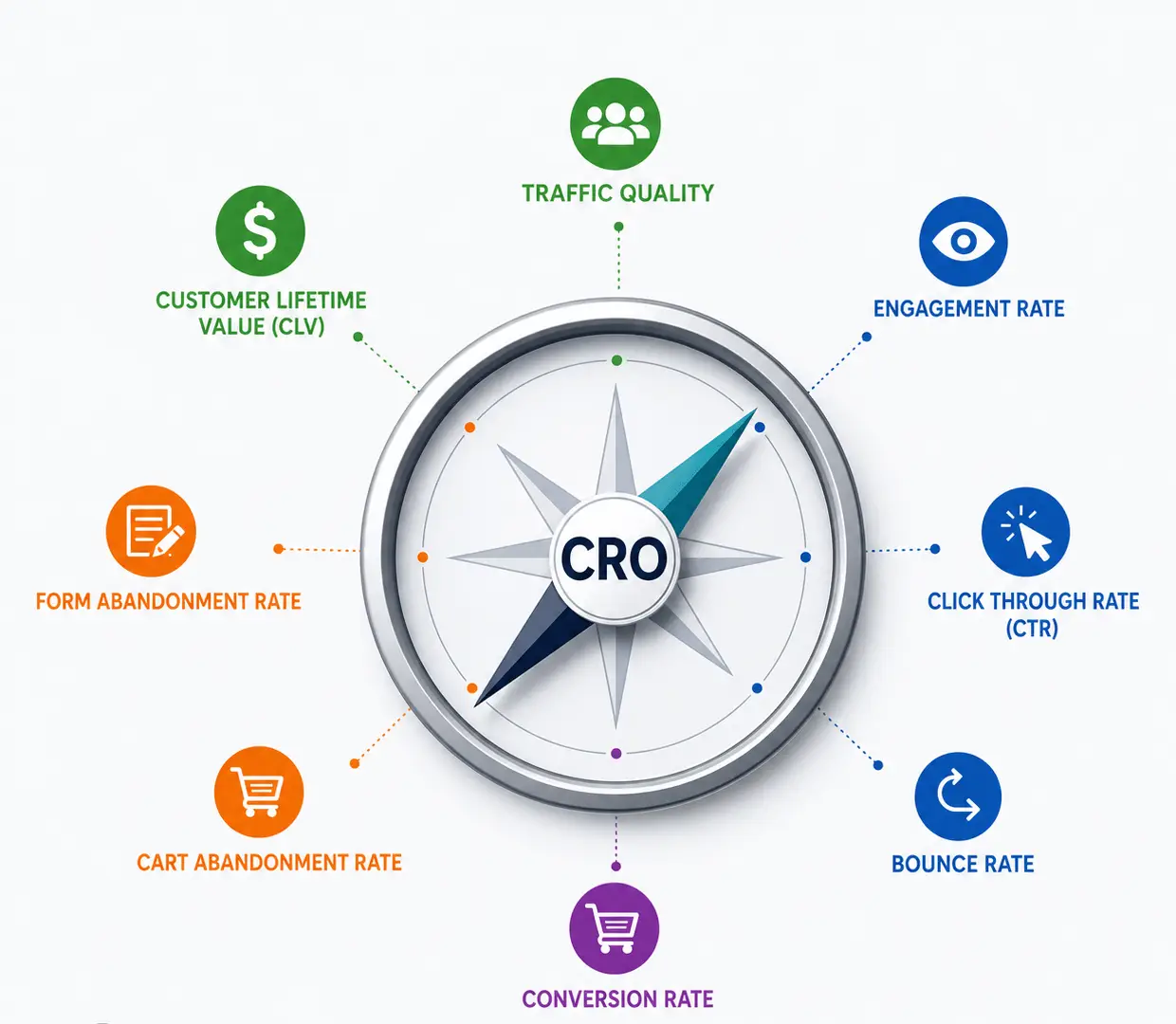
At its core, conversion rate optimization (CRO) is like giving your website a gentle, data-driven makeover with one goal: turning casual visitors into customers, subscribers, or whatever action you desire. The “conversion rate (CvR)” itself is simply the percentage of people who take a desired action out of everyone who visits your site.
For example, if 100 people come to your website and only 5 of them sign up for your newsletter, that’s a 5% conversion rate. With CRO, businesses can build a better understanding of their customers and increase that conversion rate (CvR) by, for example, 15% with minimal or no spending.
CRO is the process of improving those numbers, often referred to as metrics. This is done by tweaking elements like design, messaging, buttons, or navigation. It’s not magic; it’s a scientific approach packed with creativity and a whole lot of data driven insights.
Identifying Conversion Rate Metrics
Conversion rate optimization begins by identifying the conversion goals for each specific web page or app screen. The success metrics for your website or mobile app will vary based on your business type, your objectives/goals, and each page. For instance, if you have an e-commerce site, a conversion could be defined as the number of purchases made or the number of visitors who add a product to their shopping cart. If you sell products or services to businesses, you might be measuring the number of leads your website collects or the number of white paper downloads.
Here are some common conversion examples that types of organizations or industries may frequent:
- Media: Pageviews, ad views, newsletter subscriptions, recommended content engagement
- Ecommerce: Product sales, add-to-carts, shopping cart completion rate, e-mail newsletter sign-ups
- Travel: Booking conversions, ancillary purchases, social shares
- B2B: Leads generated, deals closed
Once you have established the conversion metrics for your digital interactions, you can increase conversion rates by improving your digital customer experiences.
Who Can Benefit? Spoiler: Most Businesses
If your business involves a digital touchpoint, whether it be a website, app, or landing page, you should be looking into a CRO process. Here are some closer examples of how CRO can benefit specific industries:
- E-commerce Stores: Imagine a Shopify-based online boutique offering handmade candles. The store is currently only receiving a 4% CvR. With CRO, we can help determine which product descriptions convert better or whether a red “Buy Now” button outperforms a blue one. Since shopping carts are notoriously prone to abandonment, optimizing checkout flow with clearer calls to action or trust badges can make a world of difference.
- SaaS Companies: For software-as-a-service brands, a free trial sign-up or demo request is often the critical conversion. CRO might involve streamlining sign-up forms or placing testimonials on landing pages to boost confidence and clicks.
- Local Businesses & Service Providers: Think about a fitness studio or a legal consultancy. Their website’s conversions might be appointment bookings or contact form submissions. Optimizing site speed, clarifying service benefits, or repositioning phone numbers can turn browsers into booked clients.
Bottom line for CRO is that if you’re measuring success with online actions like sales, leads, or signups, CRO is your new best friend.
The CRO Playbook: How Does It Work?
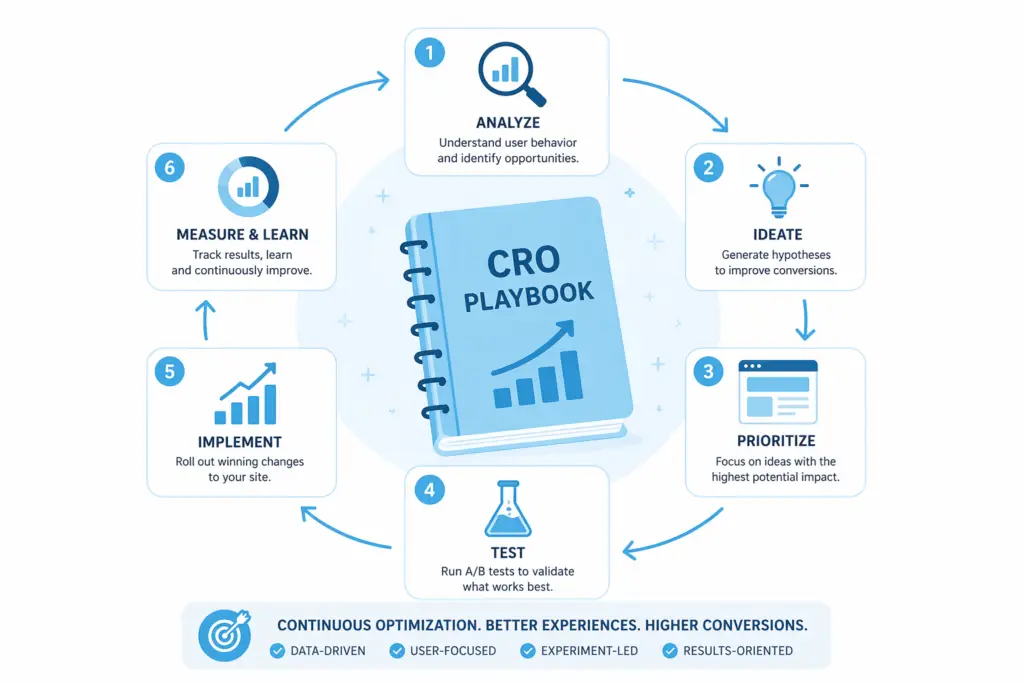
Conversion Rate Optimization (CRO) isn’t a one-off fix; it’s a cycle of continuous improvement, commonly referred to as a CRO Flywheel at The Funnel Lab Inc., formulating hypotheses of change with data to steer your experimentation in the right direction.
Here is a breakdown of the CRO Flywheel and how it would work for businesses:
- Research & Data Collection: This is where you put on your detective hat. Using analytics tools, heatmaps, user recordings, testimonials, competitor reviews, and surveys, you gather insights on where visitors get stuck or drop off as well as formulate key customer behaviors in journeys.
Let’s go through an actual scenario for the CRO playbook:
An example of research and data collection could be a Shopify store that sells handmade toys is seeing a large drop-off in completed checkout flows. Through research, we see in session replays that the shipping information is not loading well. Through segmented research and source information, women 25-34 from larger urban areas who are entering the site through Instagram tend to complete checkout more.
Knowing this information, CRO can fix the shipping issue and begin to formulate strategies on how to better target women 25-34 in large urban areas.
2. Hypothesis Formation: Based on what you learn, you create educated guesses. For instance, “Reducing form fields from five to three will increase sign-ups.”
Going back to our women segment that we found in Research & Data, we can take an educated guess that after reviewing testimonials and competitor information from women 25-34, they are more attracted to keywords such as “natural” and “organic,” so we feel that adding phrases that support natural and organic on the website will help boost sales by 25%. We get the lift number through statistics, type of change, and educated guessing. This is our first hypothesis. Usually in CRO Flywheels there will be multiple hypotheses ranging from small to substantial lifts in metric goals.
For more information about The Funnel Labs Research and Hypothesis stage, find out more about our CRO Audits that kick off our CRO playbook.
3. Testing: The real fun begins with A/B testing, where you pit your original design against a variant to see which performs better. This could be swapping headlines, changing button colors, content, or even altering entire page layouts.
From our hypothesis example, we build a test on the header of the homepage whose original content features an image of the toy, the toy’s name, and an “Add to Cart” call to action (CTA). The test that we create changes this header by highlighting the best-selling toy from our audience (this information is gathered through research and data collection) and lists key features that include “natural” and “organic” with the “Purchase Now” call to action (CTA).
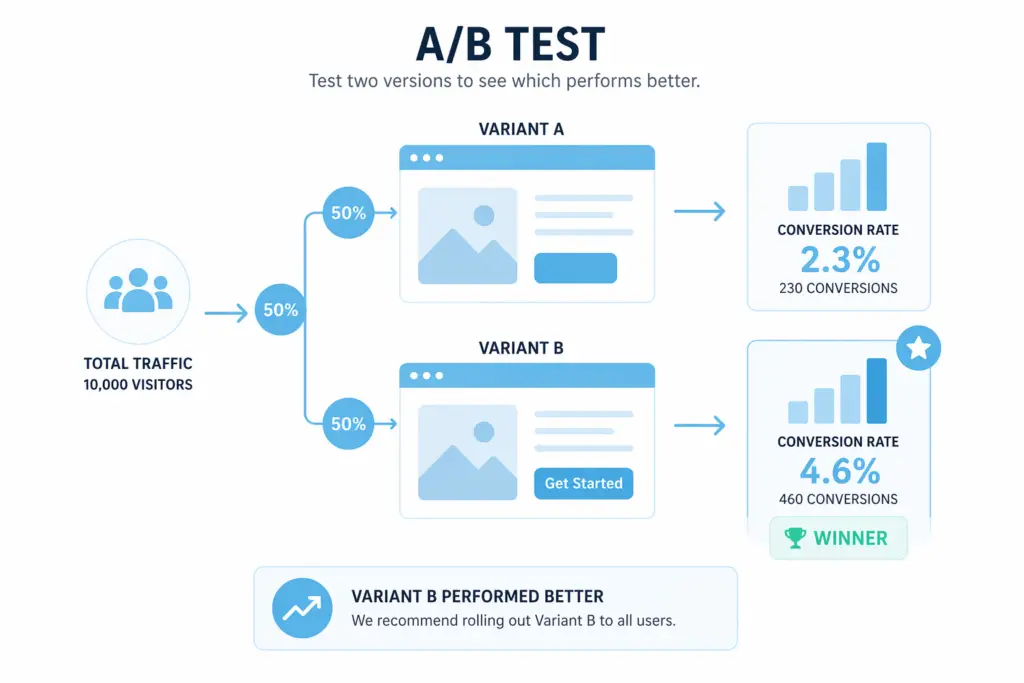
4. Analysis & Implementation: After running tests long enough to reach statistical confidence, you analyze results and apply winning changes.
For our test that we created for the toy company, after two weeks we have seen that the test is complete and has reached statistical confidence. Behold, we saw a 30% lift in sales with our test and better returning customer sales increasing Life Time Value (LTV). Actual Order Values (AOV) increase as well by 40%.
5. Iterate: CRO is a loop. Once you make improvements, you start the process again, continually refining and adapting to changing user behavior.
To wrap up our example, by reviewing the analysis and furthering our research, we can begin to build multiple hypotheses and test them based on additional findings, research, and continuous testing to further conversion rates (CvR).
Alongside A/B testing, other useful techniques include multivariate testing (testing several elements at once), personalization, landing page builds and user experience research to guide more intuitive changes.
CRO Common Practices
As mentioned above, when it comes to conversion rate optimization (CRO), achieving great results requires deliberate action and ongoing experimentation. To help your business get started, consider these essential CRO best practices that are common:
- Research Your Target Audience and Website Traffic: Understand your visitors’ pain points and behaviors to tailor your optimizations effectively.
- Test Clear Calls-to-Action (CTAs): Avoid rushing visitors. Gauge their readiness to buy and guide them smoothly to the next step.
- Keep Pages Focused: Don’t overload pages with information. Each page should have a clear, singular next step for visitors.
- Optimize for Mobile Devices: Ensure all functionalities and CTAs work seamlessly on mobile to capture the growing mobile audience.
- Reduce Page Load Times: Speed up slow-loading pages to minimize bounce rates and keep visitors engaged.
- Use Trust Signals: Incorporate customer testimonials, case studies, social proof, and industry badges to build credibility.
- Personalize Content and Recommendations: Tailor product suggestions and content based on user behavior to increase relevance and conversions.
- Analyze Engagement with Heatmaps: Identify which areas of your pages attract or lose attention and optimize accordingly.
Why Should Your Business Care?
So now that we have gone through the CRO playbook or Flywheel and have given an example of how to go through the process with certain goals, here is a closer look at various outcomes businesses could have when they employ conversion rate optimization as a part of their regular routine:
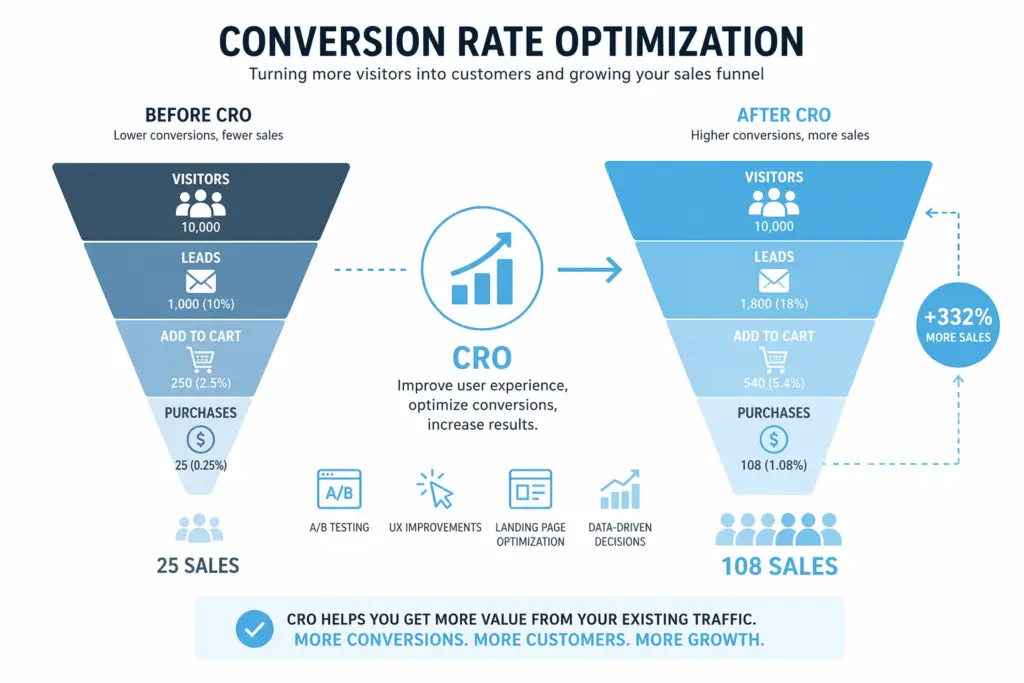
- Maximized ROI: Instead of spending more to attract traffic, CRO focuses on getting more value from the visitors you already have.
For example, an online clothing retailer can simplify their checkout process with CRO. Instead of spending more on ads, they improved the conversion rate (CvR) by 15% by adding a checkout widget rather than a checkout page, reducing the number of times a buyer has to jump from page to page.
- Better User Experience: CRO naturally leads to clearer, friendlier websites, making your audience feel understood and appreciated.
An industry example is a SaaS company noticing users dropping off during sign-up. By optimizing the form and adding clear instructions, they reduced friction, leading to a 20% increase in trial sign-ups and happier customers.
- Competitive Edge: In saturated markets, a small increase in conversion rates can be the difference between growth and stagnation.
A local gym revamped its website with clearer calls to action and faster loading times. This small change helped them attract more membership sign-ups, outperforming nearby competitors who hadn’t optimized their sites.
- Small Business Growth: CRO is not just for the big players. Small businesses and startups can see outsized gains simply by making their websites more thoughtful and user-friendly.
A handmade jewelry shop improved product descriptions and added customer reviews, boosting conversions by 25%. This growth helped them expand their marketing budget and reach new customers.
When businesses have a CRO strategy, they are able to:
- Increase revenue per visitor
- Lower customer acquisition costs (CPC)
- Get more value from existing visitors/users, or increase their Lifetime Value (LV)
- Acquire more customers and grow your business
Wrapping Up
Conversion rate optimization (CRO) might sound like a technical buzzword, but at its heart, it’s just about understanding people—what makes them click, hesitate, or close the tab. It’s a blend of psychology, design, and data science that doesn’t just boost numbers but builds better online experiences.
If you’ve been curious about testing new ideas on your website or wondering whether your visitors are getting lost somewhere, CRO offers a roadmap to turning data into better experiences and revenue.
Contact our team today to discover how CRO can better assist your business.
Like what you read?
Join our newsletter mailing list today for weekly learnings, case studies and discussions on upcoming market trends.
About Us
The Funnel Lab is a boutique conversion rate optimization (CRO) agency that wants to help your business reach its full potential.
- cro@thefunnellab.com
Recent Post
- All Post
- CRO
- Back
- Data
- Basics