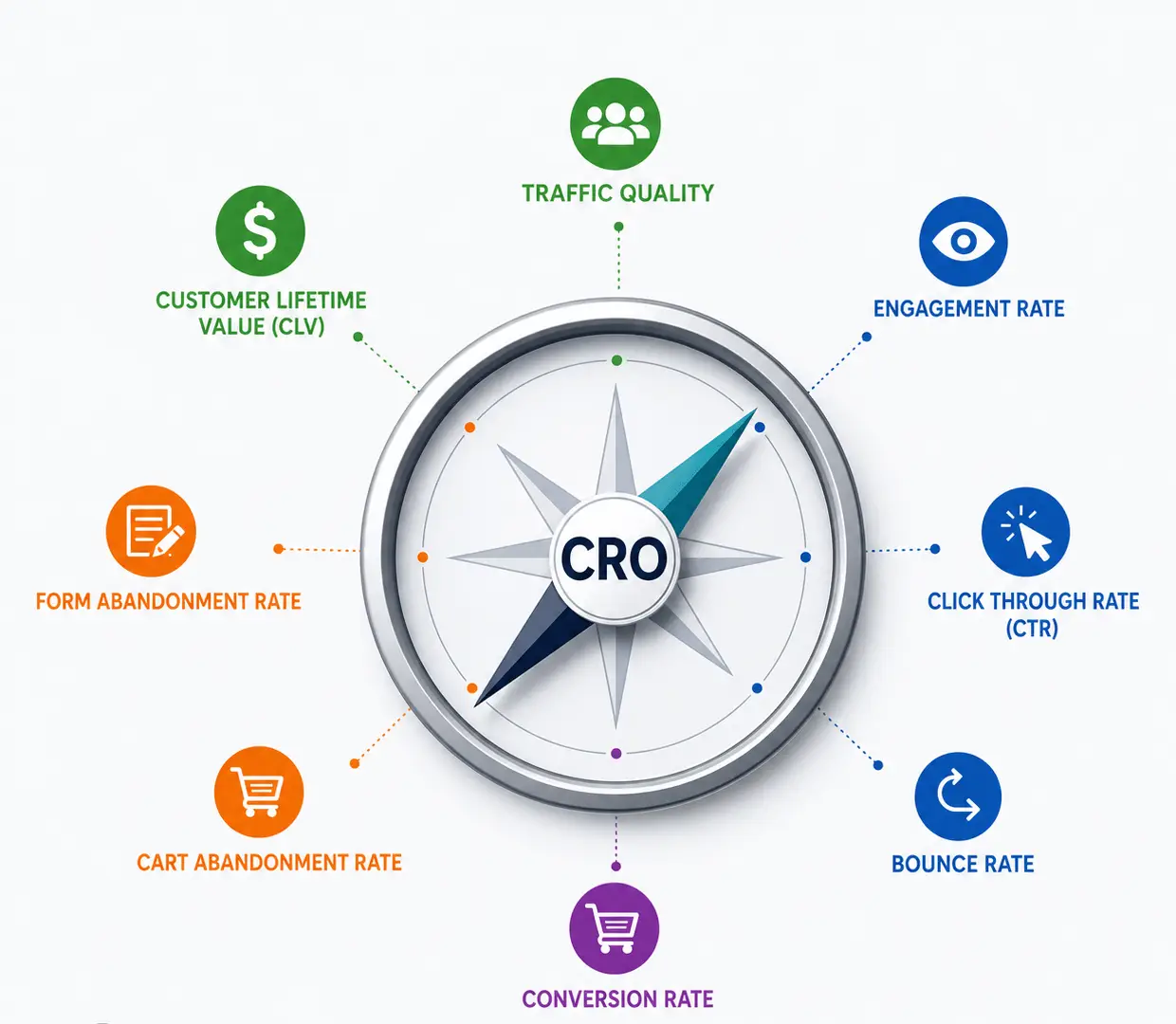

In today’s competitive digital landscape, simply attracting visitors to your website is not enough. Now, the true measure of success is converting those visitors into customers or subscribers and leads. This is where businesses should turn and begin to lean into conversion rate optimization (CRO) and more specifically, to a CRO Audit. CRO audits have become a crucial step for any business aiming to maximize its online effectiveness and build from customer understanding.
What is a Conversion Rate Optimization (CRO) Audit?
A conversion rate optimization audit is a comprehensive evaluation of a business’s current digital standing with the goal of identifying obstacles, unique behaviors, segments, bottlenecks, and pain points within the funnel that are preventing visitors from completing a desired action like making a purchase, filling out a form, or signing up for a newsletter. Audits analyze various elements, including site design, user experience (UX), content quality, and technical performance. By uncovering these issues, businesses gain actionable insights to optimize their site and increase the percentage of visitors who convert into customers or leads.
For example, an online apparel retailer selling clothes might discover through a CRO audit that slow-loading product pages or a complicated checkout process are causing customers to abandon their carts. Addressing these issues can significantly boost sales without needing to increase traffic.
Understading the stages of a CRO Audit
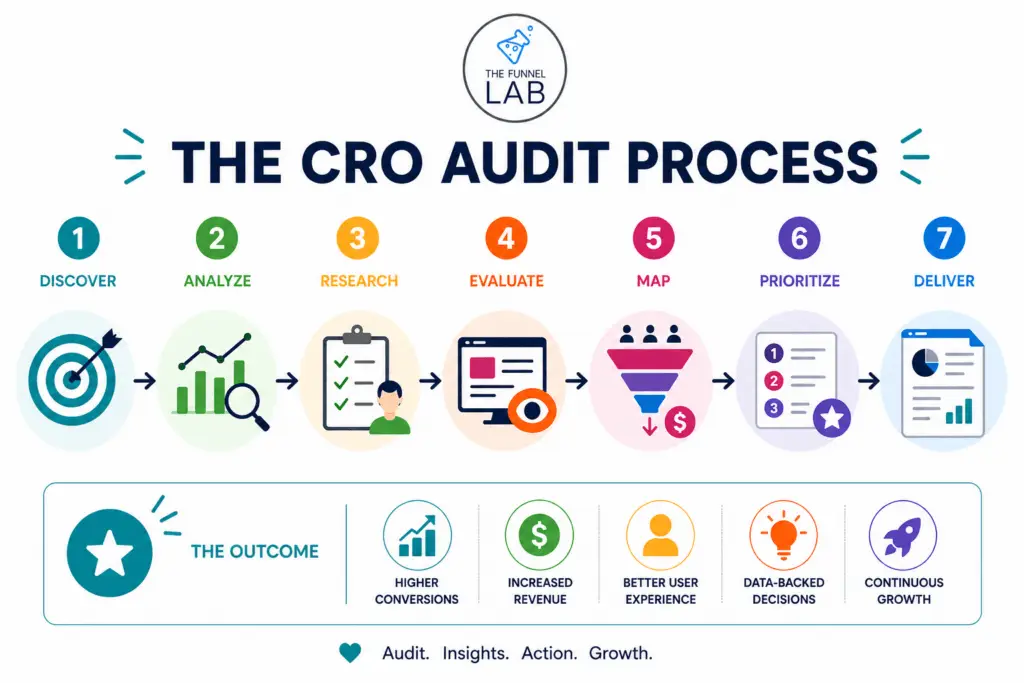
A Conversion Rate Optimization (CRO) audit is a powerful process that uncovers hidden opportunities to boost your website’s performance. It starts by analyzing both hard data and user insights to understand how visitors behave and why they may hesitate. Afterwards, it evaluates your site’s design, technical health, and how you stack up against competitors. SEO analysis adds another layer by revealing which keywords bring valuable traffic and where you can improve. From these findings, targeted hypotheses are crafted and prioritized to maximize impact. Finally, a clear, an actionable report guides your next steps to turn more visitors into customers—making your website work smarter, not harder. Let’s break down each step more so and provide business examples:
- Data Collection and Analysis
The audit begins by collecting from different data sources, ensuring we collect
Quantitative Data: This data provides measurable, numerical insights into user behavior and website performance. It helps identify patterns, trends, and problem areas through statistical analysis.
Qualitative Data: This data gives context and understanding about user motivations, frustrations, and experiences—essential for uncovering the “why” behind the numbers.
Example: A software-as-a-service (SaaS) company might notice that many visitors sign up for a free trial but never upgrade to a paid plan. Data analysis could reveal confusing pricing information or insufficient onboarding content.
2. Heuristic Evaluation
For the heuristic evaluation, we review the website’s usability and design against UX best practices. This includes evaluating navigation simplicity, clarity of calls-to-action (CTAs), content relevance, and visual hierarchy to identify friction points that impair conversions.
3. Technical Assessment
This phase tests site speed, mobile responsiveness, browser compatibility, and overall technical functionality. Technical issues can frustrate users, leading to lost conversions.
Example: A travel booking platform might realize that slow load times on mobile devices cause potential customers to leave before completing their reservations.
4. Competitive Benchmarking
Comparing the website with competitors highlights industry standards and opportunities for differentiation. Businesses learn what features or user experiences competitors offer that they currently lack.
Example: A subscription box company might discover competitors use customer reviews and unboxing videos more effectively to build trust and drive conversions.
5. SEO Ranking
SEO rankings are closely tied to the keywords and search queries driving traffic to your site. By analyzing which keywords rank well and attract visitors, a CRO audit can better understand the intent behind the traffic.
Example: A SaaS company has identified that the keywords that they are currently presenting on page 5 of Google searches with their current keywords and only have a 1% share of voice compared to competitors which is depleting traffic volumes.
6. Hypothesis Development and Prioritization
Based on the collected insights, the audit team creates hypotheses on which changes will most improve conversion rates. These are ranked by potential impact and ease of implementation.
Example: A financial services firm may hypothesize that simplifying their quote request form and adding trust badges will increase lead submissions.
7. Reporting and Recommendations
The audit concludes with a detailed report outlining findings and prioritized recommendations for optimization. This roadmap supports strategic decision-making and resource allocation.
The Funnel Lab's CRO Audit Process
The Funnel Lab Inc. offers a unique CRO audit that provides a holistic view of a business’s current digital footprint. Our audit offers a structured four-week audit review that provides a comprehensive understanding of your website, user behavior, share of voice, and funnel journeys.
This is what our CRO Audit process looks like:
Day 1 to Day 3: Initial Setup and Configuration
- Engage with businesses to understand their current pain points and understand their goals and expectations
- Configure necessary analytic tools to collect relevant data
- Ensure data accuracy and reliability of the collected data
- Integrate social media channels for a holistic analysis
- Examine existing analytics to identify trends and patterns
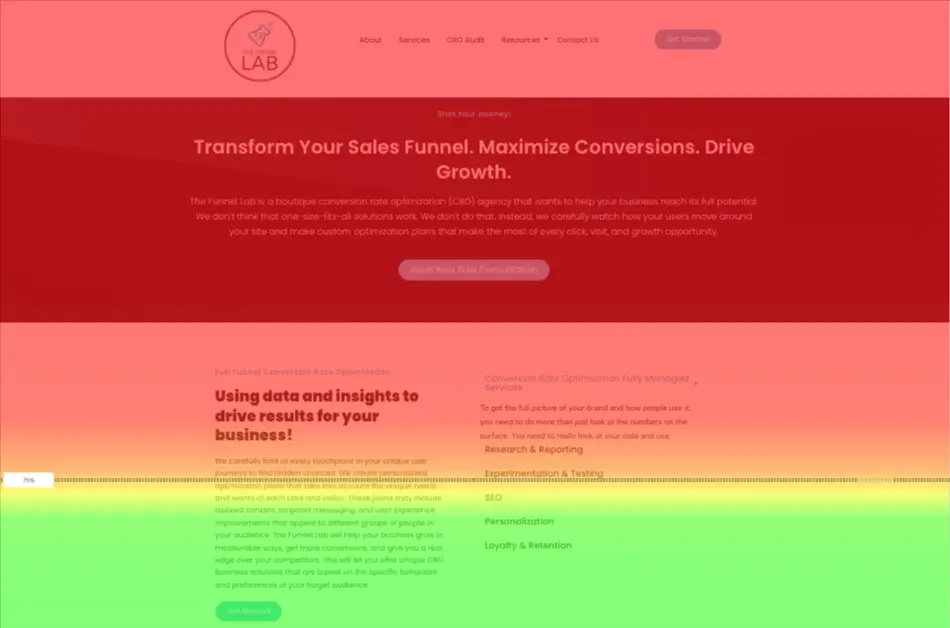
- Utilize heatmaps and session recordings to observe user behavior in real time
- Assess competitors’ websites to identify industry standards and benchmarks
- Evaluate the sites’ search engine optimization to ensure visibility
Day 11-20: User Feedback and Journey Mapping
- Create and gather user options through online surveys, polls and testimonial reviews
- Identify key audiences and map out different customer journeys to understand varied behaviors
- Revire social media and paid media performance to gauge external influences
Day 20-30: Strategy Development and Review
- Identification of gaps, pain points, and barriers hindering conversions
- Forulate hypotheses for potential improvements
- Developed personalized conversion rate optimization strategy and goals
- Meet & Review
This structured tailored approach ensures a through examination of all factors influencing conversion rates, leading to actionable insights and strategies. Find out more about The Funnel Labs CRO Audit.
Outcomes of a CRO Audit
The ultimate outcome of any CRO audit is a detailed report and strategy outlining specific issues hindering conversions and opportunities for improvement based on best practices and data-driven insights.
As a way to move forward, these opportunities should include possible A/B testing, targeted experiences for different groups, and, in the end, a way to predict how they will affect conversion rates and business goals. This will help you make smart, unbiased decisions that will improve the user experience and get more visitors to do what you want them to do.
How Businesses and E-commerce Benefit from CRO Audits
The ultimate outcome of any CRO audit is a detailed report and strategy outlining specific issues hindering conversions and opportunities for improvement based on best practices and data-driven insights.
As a way to move forward, these opportunities should include possible experimentation, A/B Testing, targeted experiences (personalization) for different groups, and in the end a way to predict how they will affect the overall conversion goal. This will help you make smart, unbiased decisions that will improve the user experience and get more visitors to do what you want them to do.
Ideally with an audit and CRO strategy, businesses should see the following benefits no matter their industry or size:
- Improved User Experience: Fixing usability issues leads to easier navigation and a smoother journey for customers, reducing frustration and increasing engagement.
Business Example: A home goods store revamped their product filters and navigation menus after a CRO audit, resulting in a 25% increase in time spent on site and a 15% lift in purchases.
- Increased Revenue:
Optimizing conversion rates means more sales or leads from the same traffic volume, improving profitability without additional marketing spend.
Business Example: A boutique skincare brand improved their checkout process by reducing form fields and adding guest checkout options, boosting their conversion rate by 30% and increasing monthly revenue significantly.
- Better Customer Insights:
CRO audits provide deep understanding of visitor behavior, preferences, and pain points, allowing businesses to tailor marketing and product offerings effectively.
Business Example: An online education platform used audit insights to personalize course recommendations, leading to higher enrollment rates and improved customer satisfaction.
- Reduced Acquisition Costs:
With higher conversion rates, businesses get more value from existing traffic, reducing the cost per acquisition and increasing return on ad spend.
Business Example: An electronics retailer optimized landing pages based on audit findings, which lowered their cost-per-sale by 20% while maintaining the same ad budget.
- Competitive Advantage:
Continuous CRO auditing enables businesses to stay ahead by adopting evolving best practices and responding swiftly to user expectations.
Business Example: A fashion e-commerce company conducted quarterly CRO audits, allowing them to quickly test new features like augmented reality fitting rooms, keeping them ahead in a competitive market.
Wrapping Up
A conversion rate optimization audit is a vital strategic tool for any business or e-commerce site aiming to maximize their digital performance. Through systematic evaluation of data, usability, technical aspects, and competitive positioning, businesses uncover actionable insights that improve user experience and drive higher conversions. Whether it’s simplifying checkout flows, speeding up page loads, or refining messaging, the benefits are clear: increased revenue, better customer understanding, and a stronger competitive stance in the digital marketplace. Investing in regular CRO audits ensures businesses continuously evolve and thrive in an ever-changing online landscape.
Find out more about CRO Audits.